
By Holly Silvers, Associate Editor | hollys@modelaircraft.org
As seen in the August 2026 issue of Model Aviation.
A PILOT IS never too young (or old!) to make history. AMA Youth members and California siblings Aurelius and Kiana Lin, who are also proud members of the National Youth Aviation Academy (NYAA), are the latest rising stars in the Free Flight (FF) community to do just that.
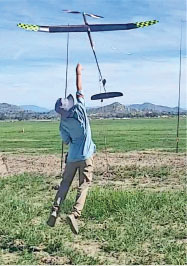
This past February, Aurelius made a record-breaking flight in F1B Wakefield, clocking 35 minutes and 18 seconds to secure a new AMA Youth Junior National Record. Not to be outdone, Kiana clinched her own AMA Youth Junior National Record in F1Q Electric Power Outdoor FF, clocking 21 minutes and 9 seconds (check out JC Zankl’s “Competition and Technical” article in this issue’s “AMA News” section to read about Kiana’s new record!).
As excellent examples of the incredible talent that is emerging out of the next generation of pilots, I had the pleasure of sitting down with the duo to talk about their flight preparations, their favorite modeling memories, and what’s on the horizon for them.
HOLLY SILVERS: How did you get started in model aviation?
AURELIUS LIN: We first started in model aviation by getting invited to Taibi Field in Perris, California. Once we were there, we began flying and crafting small balsa airplanes. After a few months of crafting those, we got invited by Coach Tim [Batiuk] to fly some Hand-Launch Gliders (HLG) and Catapult Gliders.
HS: How do you prepare for a contest?
KIANA LIN: I review my notes and everything that I’ve learned. I also give myself pep talks and make sure that everything is okay with my airplane, such as checking for cracks, ensuring that there’s no dust in it, and checking for damage, especially on fragile items like the stabilizer.
AL: Similar to my sister, I review my process. The day before [a contest], I’ll make sure that I have everything prepped and ready to go for the field. That helps me alleviate any fears that things could go wrong.
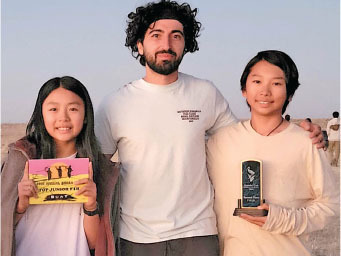
HS: Kiana, what made you want to fly F1Q Electric Power FF?
KL: I wanted to learn about F1Q after I saw other team members fly. I was very interested in how the airplane worked.
HS: Aurelius, what made you want to fly F1B Wakefield?
AL: In the beginning of my FF journey, I tested and flew F1A and F1Q, and after flying those two events, both Coach Sevak [Malkaysan] and Coach Tim decided that the best fit for me would be F1B.
HS: Is there any advice you’d like to give to other kids your age who want to start flying in events?
KL: Never give up. When you fly for the first time, there are a lot of problems with [things like] wind. During a particularly windy contest, some contestants decided to stop flying and preserve their airplanes, but I still wanted to fly. I launched my airplane and it flew well. After locating it, it had landed in a way that broke the stabilizer. FF teaches you to be a quick thinker. Don’t give up; keep on trying.
AL: Start with the basics, and then upgrade and learn how to fly the bigger airplanes.
HS: What has flying FF taught you besides flying skills?
AL: FF has taught me about the importance of collaboration and teamwork. In F1B, we have a lot of parts that are hard to do, like putting your motors into the airplane, for example. It takes a lot of strength to do it by yourself. [My team members and I] always work together, and it’s taught me how to be a better team member.
KL: Something that FF has taught me besides flying is precision—it’s important to be precise when setting the airplane up properly, such as the lines and construction of the airplane, especially when you’re in a competition because you might [otherwise] ruin your airplane.
HS: What favorite memory do you have from flying?
KL: My favorite memory is when Coach Tim—we called him Grandpa Tim—gifted me one of my first HLGs. We named it “Sol,” the Spanish word for “sun.” I will always remember when I flew Sol with him. With this airplane, I got a really good thermal, so it flew so high that the parents couldn’t even see it with binoculars. Later, Grandpa Tim said it went over the San Jacinto Mountains. It was a 100% human flight.
AL: For me, one of my favorite memories is when Grandpa Tim walked out with me for my first flight at San Valeers because that was my first competitive flight. He talked with me about how confident he was. He really boosted my overall demeanor for that day.
HS: What goals do you have for the future?
KL: My goal is for our NYAA team to go on the podium—first, second, and third—[at the Junior World Championships] in F1Q.
AL: My current goal is similar. I want the whole F1B team to hopefully place on the podium at the Junior World Championships.
HS: Do you have any upcoming competitions that you’re looking forward to?
AL: The next competition that we’re planning on going to is the San Valeers 77th Annual and 43rd Annual 7 Rounder in Lost Hills, California. That will be the last competition until the FAI F1 Junior World Championships for Free Flight Model Aircraft in Prilep, North Macedonia.
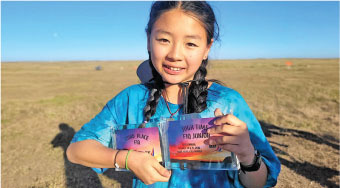
The NYAA organization was founded by Sevak and Tim, both of whom are also FF Hall of Fame inductees. Aurelius and Kiana thank their NYAA family, who have guided and helped them in many ways. Coach Sevak and Grandpa Tim ingrained into them the three pillars of teamwork, collaboration, and professionalism, and taught them how to be great competitors who are celebratory of their teammate’s wins.
Editor’s Note: Aurelius and Kiana could not attend the San Valeers and 7 Rounder contests in Lost Hills because of high wind, but they still made the drive out to commemorate a time when Grandpa Tim supported Aurelius at his first contest.
Grandpa Tim, who passed away in July 2025, had a tradition where he would pick up the airplane after a student’s first contest and say, “See? When you become a world champion, I can say I was there from the beginning.”
SOURCES:
National Youth Aviation Academy