
Editor’s note: To celebrate the 100th Nats, AMA will be running the “Nats Rewind” series showcasing the history of the event. The following is an article that was originally published in a 2011 supplemental edition of Model Aviation that celebrated AMA’s 75th anniversary.
AM I THE BEST? For those aeromodelers who ask themselves this question, competition is the key. Facing an opponent, and besting him or her, is the only true way to know.
Aeromodeling contests began almost as soon as two people could fly a model airplane. In the early days, competitions were regional affairs with exchange clubs, parks, business, and Young Men’s Christian Associations sponsoring many events.
This changed in 1915 when the Aero Club of America sponsored the first national aeromodeling contest. (1.) The contest was divided into three separate events: distance—launching from hand; duration—launching from water; and duration—launching from ground. Cash prizes were awarded to the individuals achieving the best scores each month, and the Henry S. Villard Trophy was awarded to the club with members who had the highest collective scores. (2.)
The Illinois Model Aero Club (IMAC) won the three years it was awarded, retaining the cup in 1919, and ending the only national aeromodeling event.
The IMAC recognized the need for a national event and encouraged the National Aeronautic Association (NAA) to hold an aeromodeling event. In 1923, Bernard Mulvihill, vice president of the NAA, agreed to offer prize money and a trophy if the St. Louis Air Board and the Air Race Contest Committee added the event to the schedule. After much work, Event No. 6, Mulvihill Trophy Duration Race for Model Airplanes, was added to the National Air Race Program. (3.)
For the next few years, it was a matter of who would sponsor the event as numerous groups came and went, including the Playground and Recreation Association, the American Association of Model Aero Clubs with the First National Indoor Model Airplane Contest (4.), and the Airplane Model League of America (AMLA).
When the Great Depression hit, the Nats seemed done for, but again, interested modelers prevailed. With the leadership of Lt. H.W. Alden, chairman of the NAA Model Airplane Committee and financing from Model Airplane News magazine, the Nats survived. (5.) Radio control joined Free Flight in 1937, and following a brief halt during World War II, the “Victory” Nats were back in 1946 with almost 1,000 contestants flying in 23 events, including Control Line.
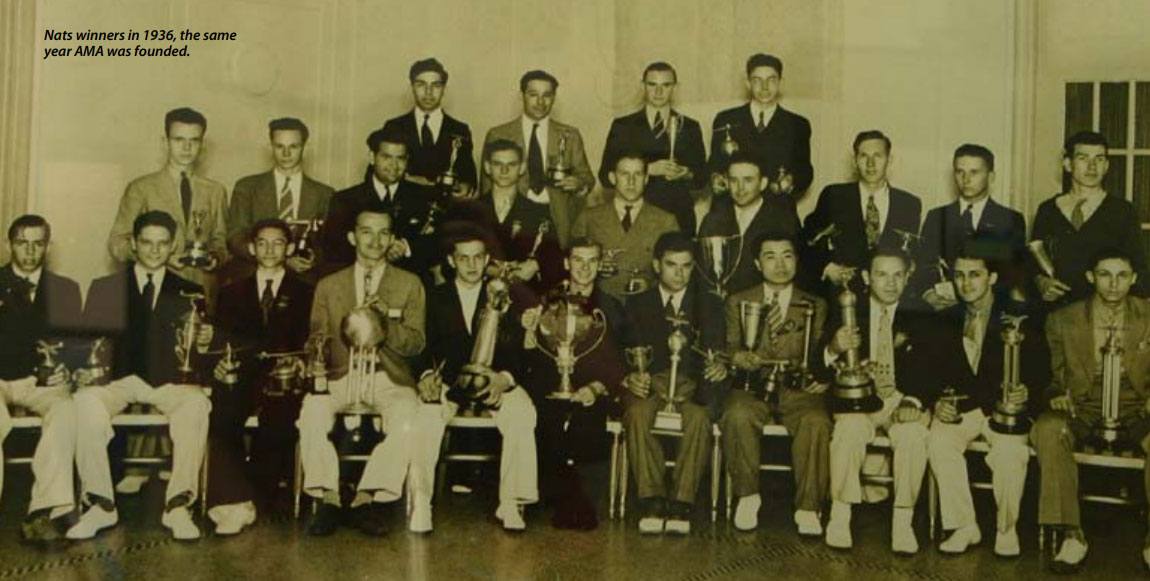
For many contestants, it was the Navy Nats, held from 1948 to 1972, that represented the glory years of the event. Each summer, a different naval air station would host the grand event, providing food, housing, manpower, and, most importantly, the great building hangars, with hundreds of tables set up for 24-hour repairs.
In 1973, AMA took over responsibility for the entire Nats, and with the help of numerous groups and sponsors, put the show on the road. For the next 23 years, the Nats would stop in 16 cities across the country. Finally, in 1996, the Outdoor Nats found a home at AMA’s International Aeromodeling Center, and the Indoor events landed at the Mini-Dome in Johnson City, Tennessee. For the last 16 years, aeromodelers from around the world have gathered at these sites to continue the quest to see who is, indeed, the best.
—Michael Smith, National Model Aviation Museum Director
SOURCES:
The First 75 Years
Model Aviation supplemental edition, 2011
modelaviation.com/thefirst75years
1936 Nats Winners
National Model Aviation Museum Collection, 2025.01.01, Muncie